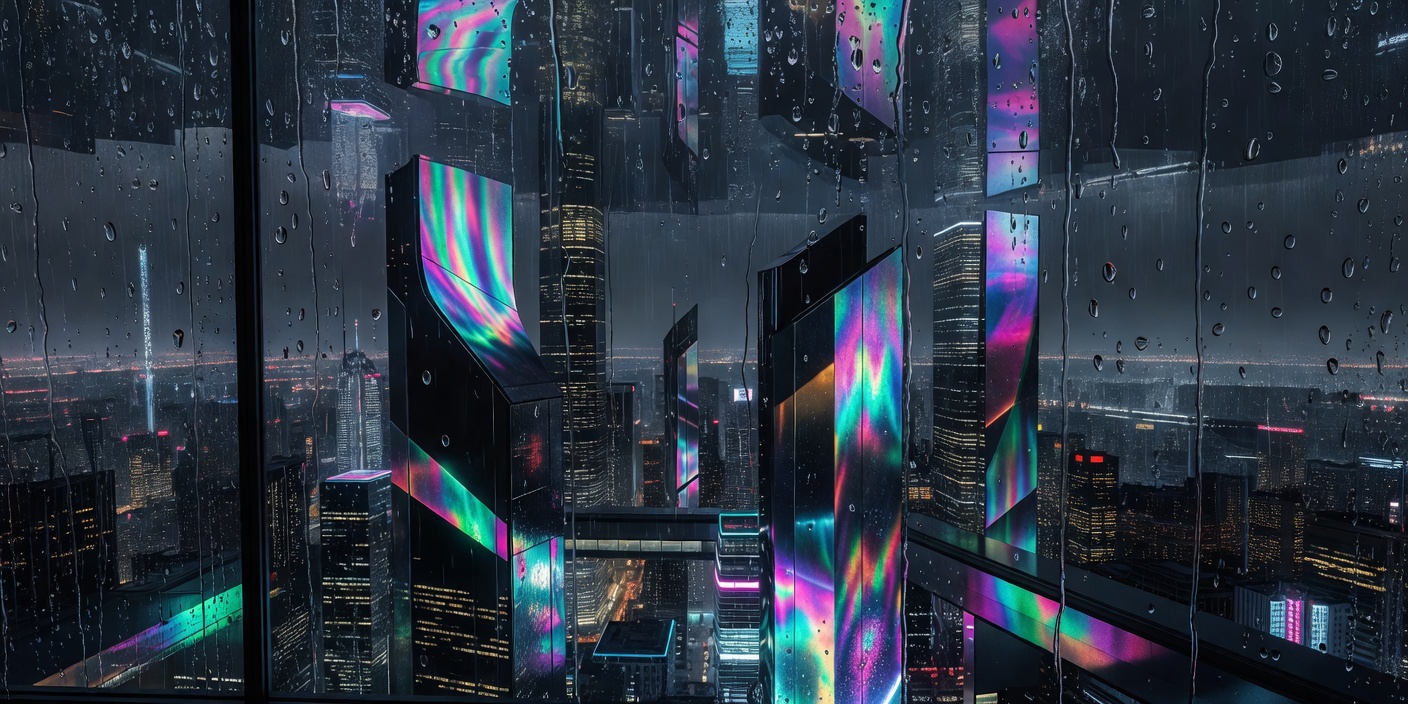
Blade Runner: noir does the heavy lifting
Blade Runner uses the investigative structure of noir to unsettle the investigator’s authority. Replicants are pursued as products, yet the film repeatedly directs attention towards their memories, fear and desire to continue living. The corporate city is not simply a striking backdrop: its scale makes individual lives appear administratively disposable.
Watch the contrast between crowded streets and controlled interiors. Access, comfort and visibility are distributed unevenly. The film’s deliberate pacing allows production design and sound to carry information that a faster plot might state outright. Different cuts alter elements of narration and closure, so identify the cut rather than assuming every discussion refers to an identical viewing experience.
Ghost in the Shell: the body is not a secure boundary
The animated Ghost in the Shell film treats cybernetic embodiment as both ordinary infrastructure and a philosophical problem. When bodies can be manufactured and memories interfered with, continuity of self cannot rest comfortably on either flesh or recollection. Its procedural action gives those questions institutional consequences instead of leaving them as abstract puzzles.
The quiet city passages matter as much as the confrontations. Reflections, mannequins and repeated human forms place the Major’s uncertainty within a broader visual system. Do not treat the film, manga and Ghost in the Shell: Stand Alone Complex as interchangeable versions of one narrative. They share concepts and characters but organise tone, continuity and political detail differently.
Akira: pressure without a neat release
Akira locates technological catastrophe inside a city already under strain. Military research, civic unrest, redevelopment and spectacular bodily mutation pull against one another. Its energy is not primarily the cool competence of the hacker or detective; it is acceleration, damaged authority and power that cannot be contained by the institutions claiming it.
The film and manga differ substantially in scope and narrative development. The film’s concentrated momentum can make the world feel larger than the explanations it supplies. That is a reason to attend to its visual relationships, not to assume the manga merely fills in omitted footnotes. Each medium makes different structural commitments.
Serial form changes the kind of unease
Serial Experiments Lain trades metropolitan spectacle for domestic rooms, electrical noise and unstable connections between ordinary life and the Wired. Repetition and ambiguity are central to its effect. Choose it when you want networked identity to feel disorientating rather than neatly explained by a single technological reveal.
Psycho-Pass approaches surveillance through institutional procedure. Its policing premise puts classification and delegated judgement at the centre: a system’s claimed objectivity becomes part of the problem. Compared with Lain’s fractured subjectivity, the procedural format provides a clearer route through questions of responsibility, compliance and the violence hidden inside supposedly neutral administration.
Pair by question, not by prestige
For manufactured personhood, pair Blade Runner with the animated Ghost in the Shell. The first leans into mortality and empathy; the second pushes towards unstable boundaries and transformation. For institutions losing control of their own technologies, compare Akira with Psycho-Pass, while keeping their very different narrative forms in view.
Subtitles and dubbing change performance and reading load; neither choice guarantees fidelity in every edition. Check the language options and content guidance attached to the specific release. These works can involve intense violence, coercion, disturbing imagery and sexual content, and the shared genre label is not a useful substitute for individual classification information.
Resist reducing every Asian city influence to exotic atmosphere. Look for the actual function of density, signage and infrastructure within the story. A skyline becomes more interesting when it tells you who can move, who is watched and who is expected to disappear into the background.